
Featured artwork: a generated illustration of the article’s subject. Screenshots and demonstrations below show the actual work.
An animated flame can come from a recording, a group of moving image fragments or a simulation. Those choices produce different movement and need different kinds of preparation. I’ve brought five selectable fire methods into FrameRudiments so the choice can be made deliberately.
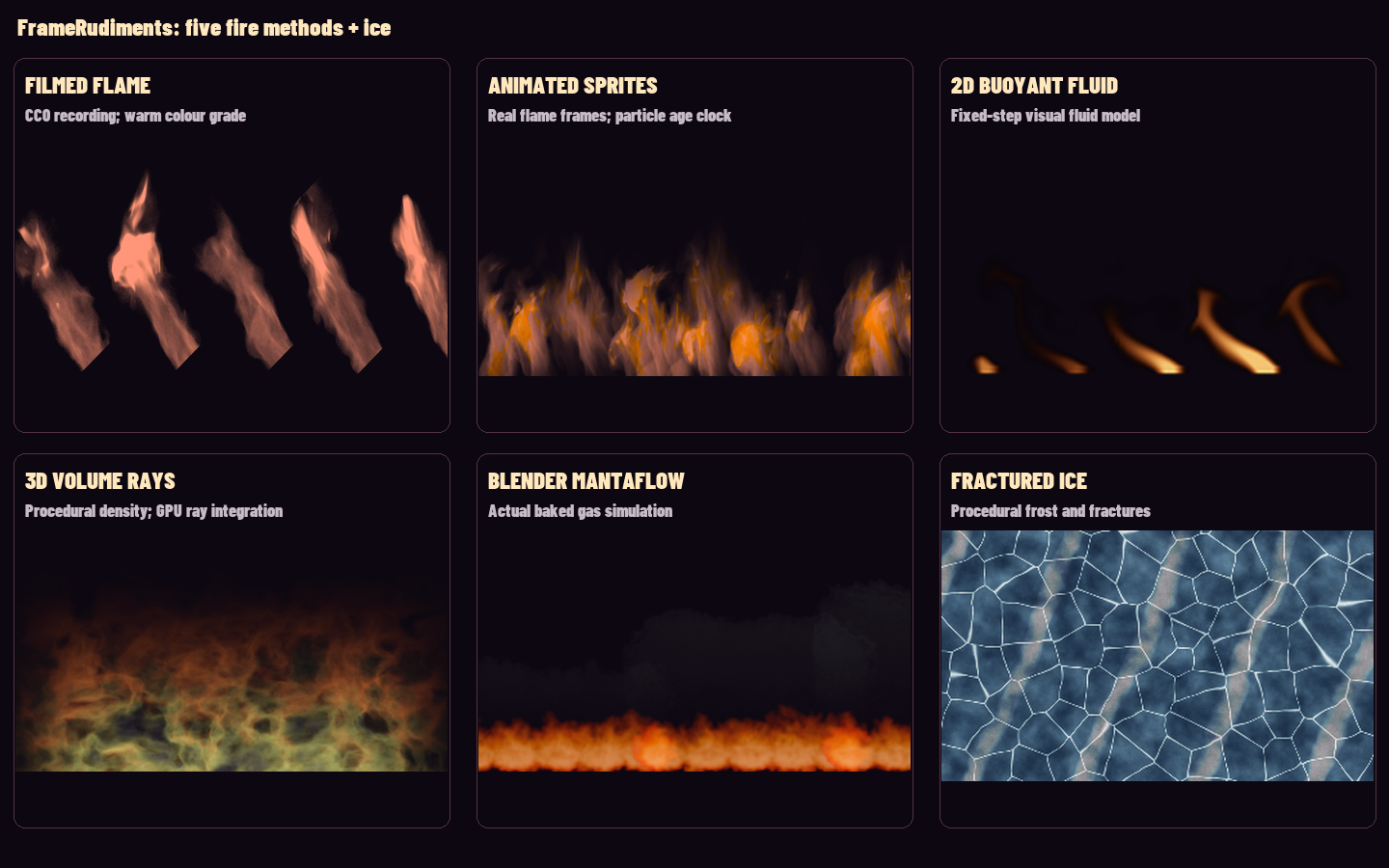
The comparison uses synthetic cards and a test tone. Its six panels show filmed flame, animated sprites, a 2D buoyant fluid model, procedural 3D volume rays, an actual Blender Mantaflow bake and fractured ice. During the second part, the fire methods burn away a card while the ice method freezes it.
The filmed route retains photographed flame detail. The sprite route rearranges frames through the existing particle system. The 2D solver models a bounded visual flow of fuel and heat. The volume renderer integrates a procedural density field. Mantaflow uses a real baked gas simulation. Those descriptions remain separate: a procedural volume does not become a fluid simulation simply because it looks convincing.
The shared interface provides artwork burn and freeze operations with explicit progress. At zero burn, the original artwork is retained; a completed burn is transparent. Freeze preserves the source alpha. This makes it possible to use an effect during an exit without forcing the held words through the same treatment.
Version 0.4.3 adds a recorded three-colour palette and varied atlas placement for wider surfaces. The comparison here is the five-method demonstration retained from 0.4.2. Its filmed source comes from the Marburg studio’s CC0 material, with the derivative and its treatment recorded in the project.
The method guide covers the settings and bounds. The final choice still needs visual review for repeated shapes, bright cores, transparent edges and interference with text.
Leave a Reply