
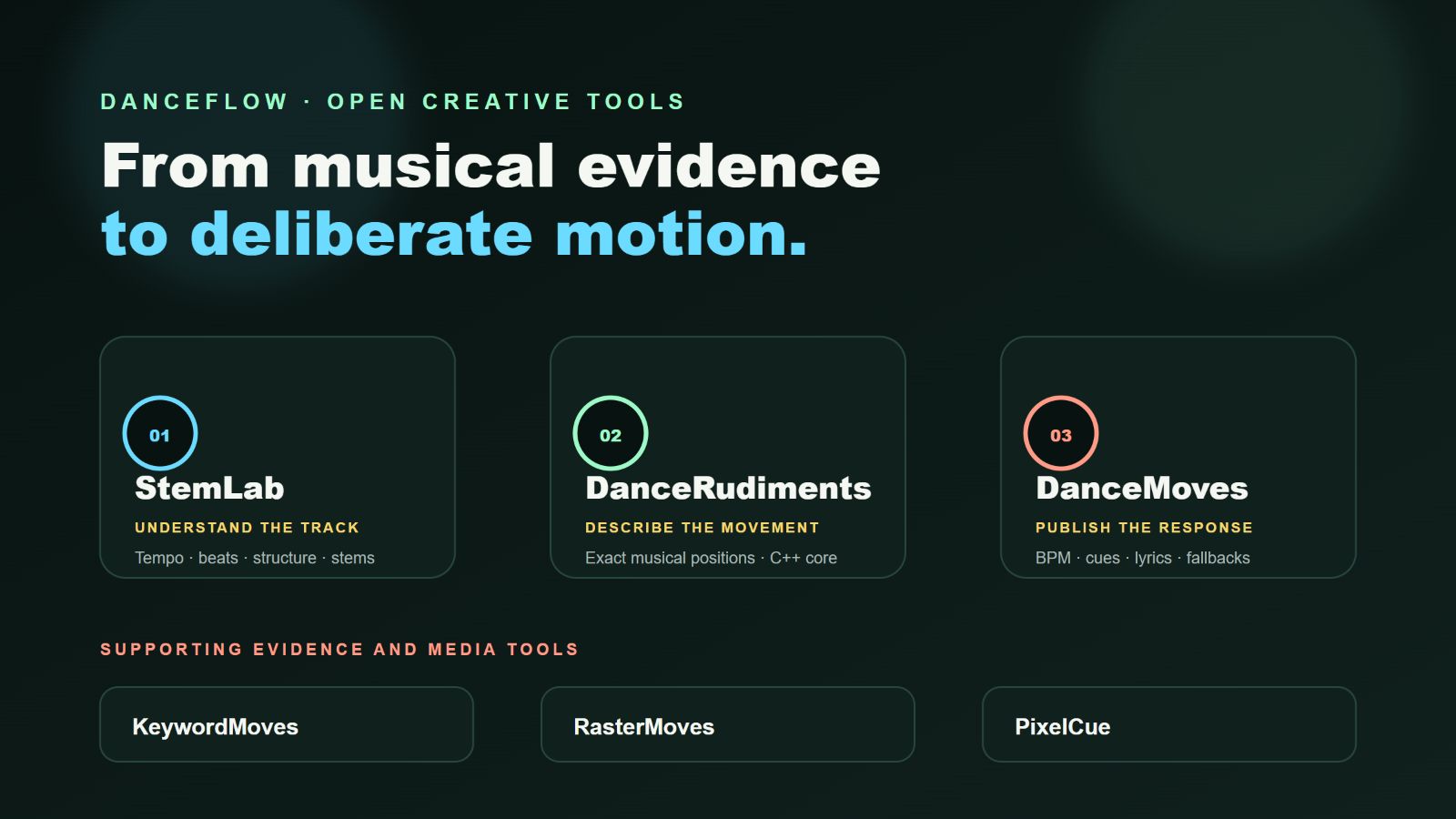
DanceFlow · open creative tools
From musical evidence to deliberate motion.
DanceFlow is a family of independent tools for understanding music and turning that evidence into motion-aware visual work. Use one part on its own, or connect them into a repeatable path from a finished track to a responsive experience.
The core path
Listen. Describe. Move.
The tools exchange explicit timing and analysis data rather than hiding everything inside one application. That keeps the evidence inspectable and lets each component remain useful by itself.
StemLab
Understand the track
Local, evidence-led analysis for tempo, beats, structure, stems, harmony, lyrics and loopable sections.
DanceRudiments
Describe the movement
Deterministic rhythmic position functions with a C++ core and bindings for creative applications.
DanceMoves
Publish the response
A browser and WordPress runtime for BPM-, cue- and lyric-timed effects, with accessibility and performance fallbacks.
Supporting tools
The work around the motion matters too.
DanceFlow also includes tools for finding audience language, understanding visual libraries and preparing source imagery. They share an evidence-first approach without pretending unlike measurements are interchangeable.
KeywordMoves
Modular keyword discovery and evidence analysis, with different sources kept in their own units and scopes.
RasterMoves
Local image upscaling and optional refinement with explicit model sources, verification and provenance records.
PixelCue
A local visual-media analysis service for tagging images and sampled video or archive content with selectable models.
Use the part you need
The repositories stay independently installable. DanceFlow is the shared route between them, not a requirement to install everything.
Try and inspect
The useful bit is what you can test.
The source, demonstrations and public results are available separately. A working example is evidence of that example—not a promise that every tool or every track behaves identically.
Try rhythmic movement without an installation
DanceRudiments includes a self-contained visualiser with synthesised beat playback and native C++/WebAssembly movement.
See a motion-aware EPK
The Arcadians press page is one public example of DanceMoves responding to a track’s structure and pulse.
Working principles
Clear boundaries make better creative tools.
Start with the problem in front of you.
If one of the tools is useful, use that one. If the whole path fits, the pieces are designed to pass evidence between them without blurring what each part actually knows.
DanceFlow is a software and creative-tool project. It is separate from the My Songs catalogue.