

Featured artwork: a generated illustration of the article’s subject. Screenshots and demonstrations below show the actual work.
FrameRudiments is the offline video-composition part of DanceFlow. It brings audio excerpts, timed words, movement, graphic layers and effects into an encoded film, while keeping their relationship to the original song inspectable.
The division of work stays useful. StemLab supplies saved musical and timing evidence. DanceRudiments supplies native movement. FrameRudiments samples and composes those parts into frames. A section taken from the middle of a recording can retain its original lyric and cue positions while the renderer maps it into the output.
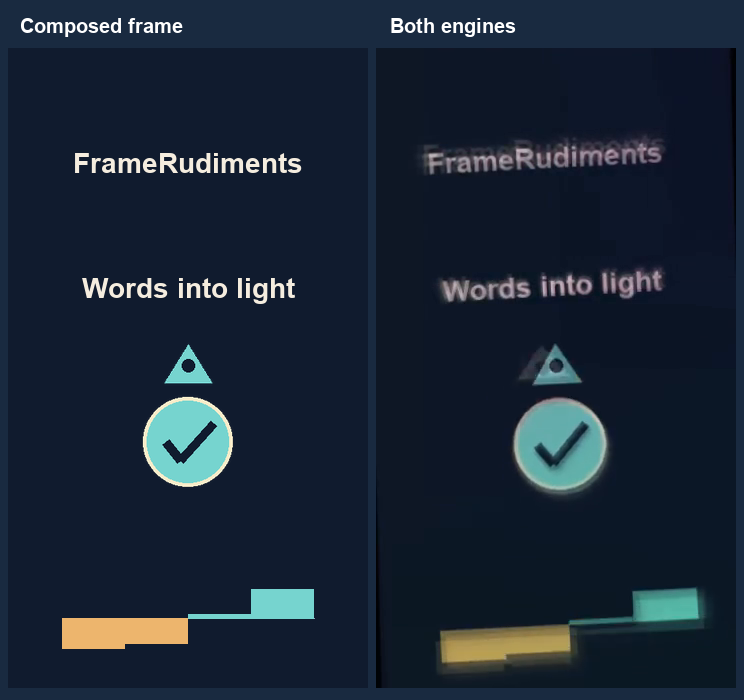
This four-second synthetic demonstration runs the complete picture through Butterchurn and projectM effects, including the words and moving shapes. Its oscillator sound is a test signal. The visible lines progress through Signals into motion, Words into light and Keep the clock in sight, then clear before the clip ends. The demonstration was made during the 0.1.4 work; the later releases retain this pipeline.
There is also a native petal-ring renderer, shown below. Its independently controlled scale, rotation and lift can be composed with the existing lyric and layer system. The example demonstrates geometry and typography; its own recording does not establish the separate GPU-background checks.
Choosing effects has become a more deliberate job too. The pinned preset inventory contains 14,680 distinct entries, while bounded profiling compares actual output with its source and with programme/silence controls. Inventory, successful rendering, measured response and artistic selection are recorded separately. There is no need to run the entire collection for every video.
The release and profiling guide contain the supported routes. The practical result is a reusable workbench for composing and checking a film, with room for each song’s own artwork and scene decisions.
Leave a Reply