
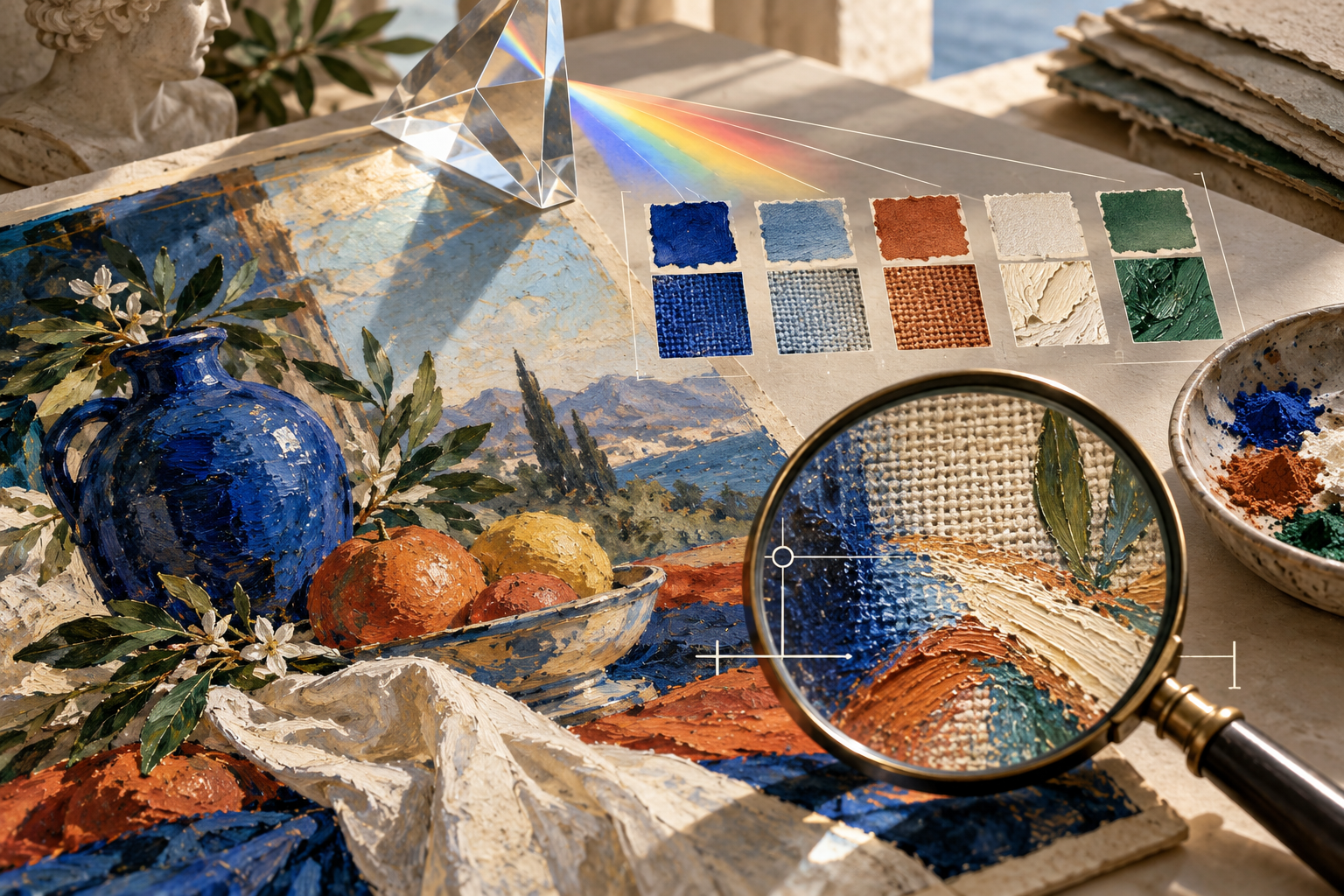
Featured artwork: a generated illustration of the article’s subject. Screenshots and demonstrations below show the actual work.
PrismMoves gives me a more structured way to examine an image before extending its visual language. It calls PixelCue for the measurements and organises the result into an evidence ledger, a readable report and a self-contained HTML view.
For this article, I ran the newly generated illustration through the current PrismMoves 0.2.0 and PixelCue 0.9.1 runtime. The report below is actual output from that run. The illustration is conceptual artwork; the palette and spatial measurements are computed from its pixels.
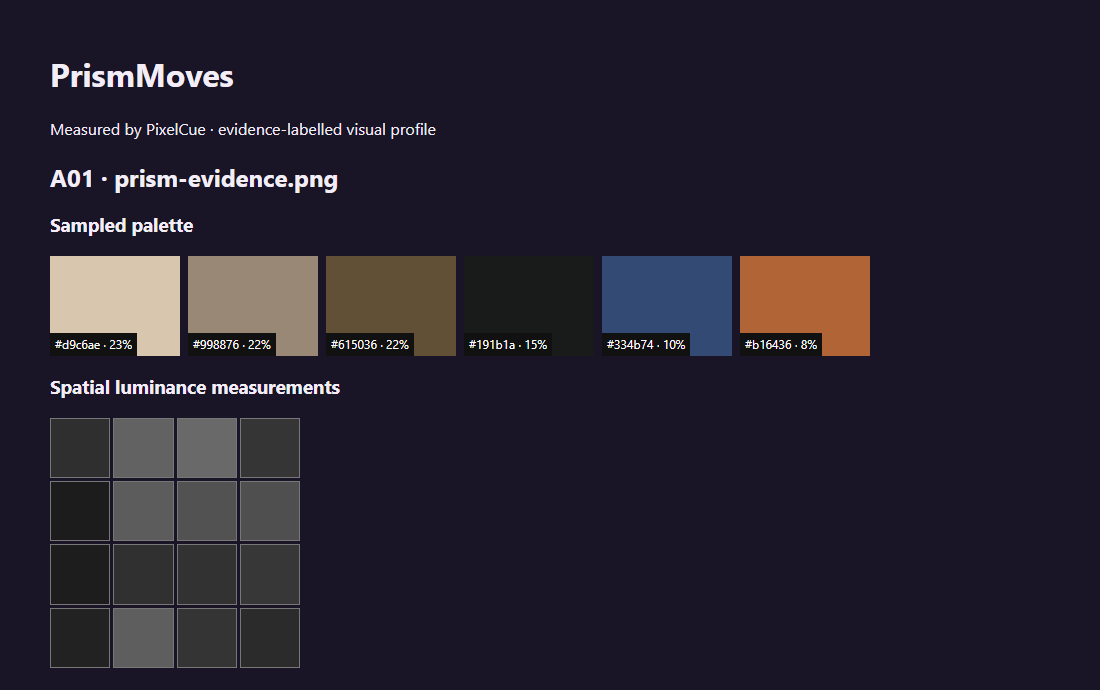
The source is 1536 by 1024 pixels, analysed at 768 by 512. Its sampled palette includes a warm pale neutral at about 23 per cent and a blue centre at about 10 per cent. Those are approximate sampled colour centres. They give a more useful starting description than an unexplained overall quality score.
The same report records luminance, saturation, edges, texture, symmetry and spatial-frequency evidence, alongside the image hash and colour handling. This run requested no semantic or OCR models. It makes no model-derived claim about the objects, emotional tone or intended meaning of the picture.
Optional captioning and embedding models can add hypotheses when they serve a real question. Their results remain separate from measurements, and unavailable analysis stays visible. A still-image report also leaves motion, responsive layout, rights and audience response to other evidence.
PrismMoves is a small reporting layer around PixelCue, rather than another image-analysis engine. The source and usage guide explain how to reproduce an individual profile and what must be reviewed before drawing conclusions about a whole collection.
Leave a Reply