

I put KeywordMoves and vidIQ through the same ten music queries, including friendship, grief, protest songs and night driving music. I used vidIQ’s free web interface and KeywordMoves’ Datamuse and Wikipedia adapters, then kept their evidence separate.
vidIQ returned eight numerical seed estimates and two displays below 750. Those are worldwide YouTube estimates. The free KeywordMoves sources returned 226 words or topic titles, without a YouTube search-volume metric. A long candidate list wasn’t answering the same question.
The suggestions needed closer attention too. For “songs about friendship”, vidIQ returned “friendship songs”, “preschool songs” and “songs for kids”. One looked useful for the music I’m researching; the others addressed a different audience.
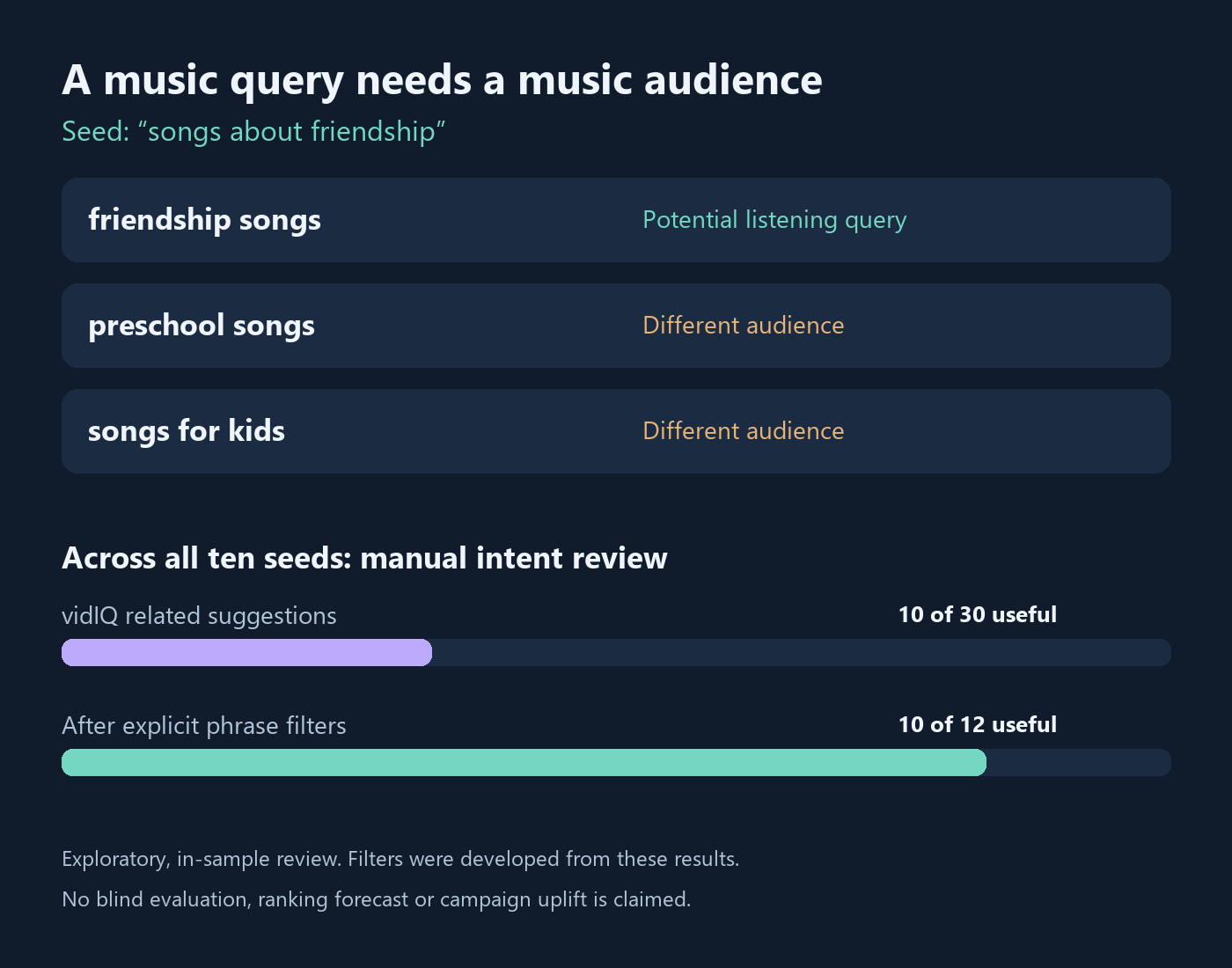
Across the ten queries, I classified ten of vidIQ’s thirty related suggestions as useful direct listening queries. None of Datamuse’s first three words per query met that criterion. This compares two particular discovery routes, rather than every feature of either tool.
KeywordMoves 0.5.1 now imports saved vidIQ keyword results while preserving country context, censored figures and provider dates. It also adds explicit phrase filters and matching terms, with the original evidence kept alongside every retained candidate.
The filters retained twelve vidIQ suggestions, including all ten I had found useful. They were developed from these same results, so this is an encouraging check on the change, rather than an independent test of how it will perform on new searches.
There’s still a gap: importing vidIQ’s estimates doesn’t give KeywordMoves an independent YouTube demand model. The useful result here is a clearer research queue and a better way to bring sources together, while keeping their limits visible.
Source context: vidIQ keyword research, Datamuse’s word API and the KeywordMoves import and comparison guide.
Further checks on free sources
I extended the source review to 22 services. Some clearly described relative interest, autocomplete suggestions or Google search volumes. Others returned monthly figures that needed more scrutiny. A newly invented random string received 7.2K searches in one tool; another reported 46.6K and then 50.3K on an immediate repeat. I kept those figures out of the demand records. These checks expose a reason to pause, rather than proving how any provider calculates its data.
A useful additional route was vidIQ’s public keyword overview, which showed five US monthly estimates and five rising queries. KeywordMoves 0.5.3 imports reviewed HTML from that feed while retaining rounded displays, source dates and the distinction between monthly counts and seven-day growth. The rising section leaves its geography unstated, so the importer does too.
This expands free access to vidIQ’s data. It still uses the same provider, and the featured feed cannot answer arbitrary keyword queries. The full source audit records the working route, rejected numerical claims and access limits. I haven’t found an additional independent free volume provider that passed these checks.
I also checked sources that offer useful keyword context without a YouTube monthly estimate. KeywordMoves 0.5.4 adds a YT Keyword Tool module for reviewed suggestions and extends Keywords Everywhere with a free import of Google planning figures. The first real replay retained 113 suggestions and 28 rows with Google metrics, keeping batch-relative tiers, Google volumes and paid-ad competition separate. Navid and Keyword Tool Dominator produced many expansions for the invented control string, so their search-data claims remain on hold. Rapidtags required an account and DigestSEO reported an unavailable API key. The module guide explains the working imports and those limits.
Automatic collection, 12 October 2026
KeywordMoves 0.5.5 removes the manual HTML step for the working YT Keyword Tool and Keywords Everywhere routes. It can fetch the first tool’s public-form response directly, or operate the free tools’ ordinary forms through a connected browser and pass the results straight into its existing parsers.
The live check returned 107 suggestions for “songs about friendship”. A bounded Keywords Everywhere harvest displayed 21 rows; 19 contained Google planning figures and two had no measurements to retain. These remain different kinds of evidence: provider-ranked suggestions and Google search context. Neither becomes a measured YouTube monthly total.
The collector checks the visible free quota, keeps the source’s own pacing and stops when access or scope cannot be verified. The public vidIQ HTTP route still returned a rate limit at its robots-policy check, so it stayed unavailable rather than switching clients. No paid calls or new accounts were used. The collection guide explains the direct and browser routes, their limits, and the local handoff needed where a browser host does not permit subprocesses.
Native YouTube Search trends, 13 October 2026
KeywordMoves 0.5.6 adds automatic collection from Google Trends’ normal CSV download. Through a connected browser, it checks the search term, country, date range and YouTube Search filter, downloads the chosen chart and passes the original data straight to the existing parser.
For “songs about friendship”, the live check retained 53 weekly observations and used 52 completed weeks in its summary. A second export contained 31 related-query rows across Top and Rising. These are sampled relative indices and growth displays, including Breakout labels. They don’t supply a YouTube monthly search total.
A connected, authorised browser is still required. The collector stops when access, download or scope checks fail. vidIQ’s public route again returned a rate limit at its robots check, so it remains unavailable. The updated collection guide explains the native download and direct parser handoff. No paid requests or new accounts were used.
Matched comparisons, 13 October 2026
The next sweep returned 1,611 suggestions from 49 generic music topics. The wording still needed a song-fit review: a tutorial, another artist’s track or a children’s song can share words with an original and address the wrong audience. KeywordMoves 0.5.7 can now require both listening context and a relevant topic, while keeping the original source values and reasons for exclusions.
I also compared five terms in one native Google Trends YouTube Search export. That shared comparison matters: five separately scaled peaks of 100 would not tell us which search had more relative interest. The figures below use Worldwide scope and 52 completed weeks from the past-year export; the unfinished week is excluded.
| Search term | Completed-window display |
|---|---|
| protest songs | 11.0192 |
| songs about friendship | 4.6731 |
| night driving music | 2.8654 |
| songs about grief | Reporting bounds 0.0961 to below 0.1154 |
| songs about ADHD | Reporting bounds 0.0192 to below 0.0385 |
The bounds retain the uncertainty in a displayed “<1”. They are not confidence intervals. The many displayed zeroes for grief and ADHD do not mean nobody searched. Google explains the low-volume threshold and statistical noise; its search-term guide also explains that unquoted terms match their constituent words, rather than only one exact phrase.
These results do not validate or disprove vidIQ’s monthly estimates. The measurement windows, term definitions and sampling differ. Six further free planning collections returned 49 rows with Google figures, which remain Google evidence even though the tool’s page is called a YouTube keyword tool. A longer candidate list still does not give us an independent YouTube volume model.
The native five-term CSV downloaded successfully. A later automated refresh showed a source display error and timed out, so I have not counted it as a successful live multi-term collection. The collector now stops early on that visible error. The assessment guide records the matched-export rules and limits. The released package passed 2,213 Python tests and 37 synthetic browser checks, and its GitHub and PyPI files were verified before installation.
13 October: turning a candidate list into a shortlist
KeywordMoves 0.5.8 adds a reviewed shortlist selector. It works from an exact, hashed candidate pool and recorded judgements about relevance, listening intent and wording. It selects five candidates by default, limits repetition across declared groups, and records selection reasons, omissions and any shortfall.
The selector preserves the source measurements alongside those judgements. It does not infer song fit or produce a new search-volume estimate. A useful phrase still needs a clear connection to the song, and missing YouTube demand remains missing. The shortlist guide explains the review contract and a reproducible example. The release passed 2,243 Python tests and 37 synthetic browser checks; its GitHub and PyPI package files were independently verified before installation.
Leave a Reply