
Music, motion and media tools
Stable 1.0.1 · destination-host acceptance requiredDanceVault
Controlled delivery. Explicit limits.
DanceVault is a stable WordPress component for encrypted, password-controlled downloads. It keeps delivered files outside the public Media Library workflow and provides expiry and revocation controls. Released Apache/nginx HTTP acceptance and the intended destination host are separate checks.
Run the hosting checklist with synthetic fixtures on the intended host before private-file use. Released test acceptance does not establish that destination or an external security audit.
What you can do with it
Encrypted WordPress downloads
Evaluate a private file-delivery workflow in an isolated test environment with synthetic files. The plugin encrypts stored bytes, checks an authorised download request and verifies the container before emitting plaintext. It must pass the documented WordPress, Apache/nginx and temporary-storage checks before handling real private assets.
Encrypted stored bytes
A libsodium secretstream container stores authenticated ciphertext rather than the original file.
Request controls
Passwords, expiry, revocation and best-effort failure limits govern new requests.
Acceptance before real use
The released HTTP suite covers actual WordPress under Apache and nginx. Destination-host acceptance and an external security audit are separate and are not established by those test results.
Output you can inspect
Try DanceVault.
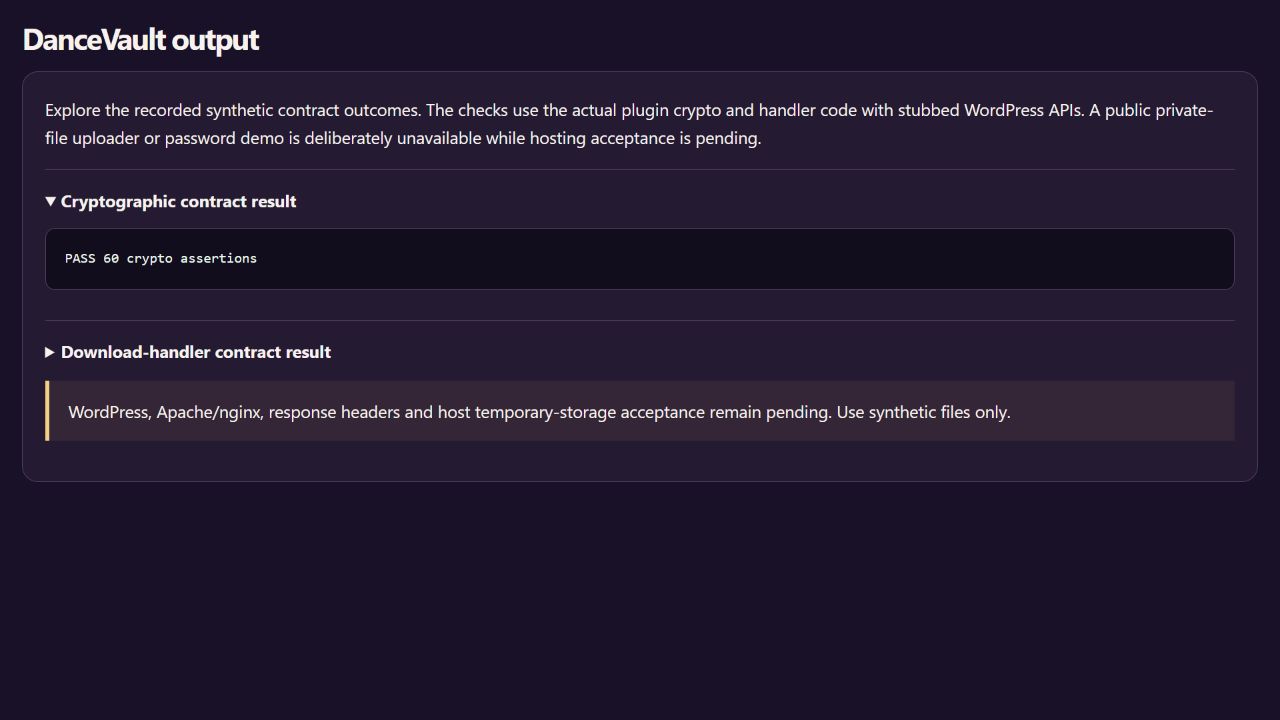
Explore the historical synthetic contract outcomes below. Those checks used the actual plugin crypto and handler code with stubbed WordPress APIs. The stable release now also has real WordPress/Apache/nginx HTTP acceptance. This overview does not provide a private-file uploader or password demo.
Cryptographic contract result
PASS 60 crypto assertions
Download-handler contract result
PASS 9 download-handler contract cases
Historical 0.1.2 synthetic results. The stable release adds WordPress/Apache/nginx HTTP acceptance; the intended destination still needs its own checklist.
Choose your route
Install and start.
For people
This is a stable GitHub release. Require HTTPS, PHP with sodium and private upload/temp storage. Apache and nginx have different access-control configuration. Do not upload real private files before the full hosting acceptance checklist passes.
Download dancevault-1.0.1-wordpress.zip and SHA256SUMS-1.0.1.txt.
Verify the checksum. Install the exact ZIP only in a reviewed WordPress test site.
Use a synthetic file. Check the source hash against the upload record, then exercise correct/missing/wrong password, expiry, revocation, corruption and direct-storage access. Verify the full downloaded bytes and no-cache headers through the actual host.
Checked releases and checksums · Full installation and API guide
For agents
Fetch the exact stable release and verify the checksum before proposing a test installation. Run only synthetic fixtures, retain each acceptance result and keep passwords/keys out of public pages, logs and URLs. Never infer real-host acceptance from isolated PHP tests or describe this as audited production security. Obtain a separate exact approval before using any real private asset.
php -l dancevault.php
php -l src/crypto.php
php tests/crypto.php
php tests/handlers.php
# These synthetic checks do not establish WordPress/Apache/nginx acceptance.
Portable DanceVault agent skill · Codex and Claude installation
Install the selected component as well as any client skill. Repository marketplace installation is separate from a vendor’s curated directory.
Versioned commands identify the stable package checked on 23 October 2026; the 0.1.2 synthetic chart remains explicitly historical. Check the release notes for newer versions and retain the checksum manifest. Third-party models and demo materials have their own terms.
A couple of useful questions.
Does revocation erase a file someone already downloaded?
No. It blocks new requests; it cannot remove a recipient's existing copy or stop a download already in progress.
Is DanceVault ready for production private downloads?
The stable release has real WordPress/Apache/nginx acceptance. Production use still requires the documented checklist on the actual destination, including HTTPS, access controls, headers and temporary storage. No external security audit is claimed.
Where it can fit.
Choose the components your work needs. These links describe related jobs; membership does not make every pair an automatic integration.
Current capabilities and working evidence.
Verified release 1.0.1. Encrypted, password-controlled WordPress file delivery with expiry, revocation, checksums and host acceptance.

Feature routes covered by the current guide
- encrypted-at-rest containers
- recipient links, expiry and revocation
- source/container checksum receipts
- Apache/nginx test acceptance and destination-host check
Open a working example Read every indexed capability
Check the latest stable release and the actual imported or installed identity before each new workflow. Use relevant ecosystem contracts and improve reusable gaps in their owning project.
Current capability and package audit · 23 October 2026
Current features and supported handoffs
Stable 1.0.1 is available with WordPress ZIP and checksum manifest. Earlier synthetic examples remain labelled as such; real Apache/nginx test acceptance and the destination production host remain separate.
Official stable source inspected: v1.0.1. Read the complete feature, package and example reference.
Unity recording and Potbot host handoffs keep source previews, installed runtime and qualified execution separate. Existing embedded examples retain their declared versions.