
Music, motion and media tools
Independent DanceFlow toolDanceMoves
Give motion a musical clock.
DanceMoves brings JavaScript audio reactive animation into websites and apps. It connects BPM, cues, lyrics and media playback to shared motion controllers, with readable static states and lifecycle controls built into the runtime.
What you can do with it
JavaScript audio reactive animation
Make a symbol follow a track, reveal a cue-timed section, animate a sprite atlas or build an interactive music page. Use the browser library directly, compose it with React or Next.js, or install its separate WordPress adapter. Connect the owners your effect needs: adding the library alone does not make a page react to audio.
Timing shared with playback
Media clocks keep cues, lyric stages and sprites tied to actual playback, seeking and rate changes.
Effects with owners
Pointer, orientation, native patterns and rendering controllers have explicit roots and teardown.
A useful static state
Reduced motion, forced colours, visibility and adaptive quality remain part of the integration.
Output you can inspect
Try DanceMoves.
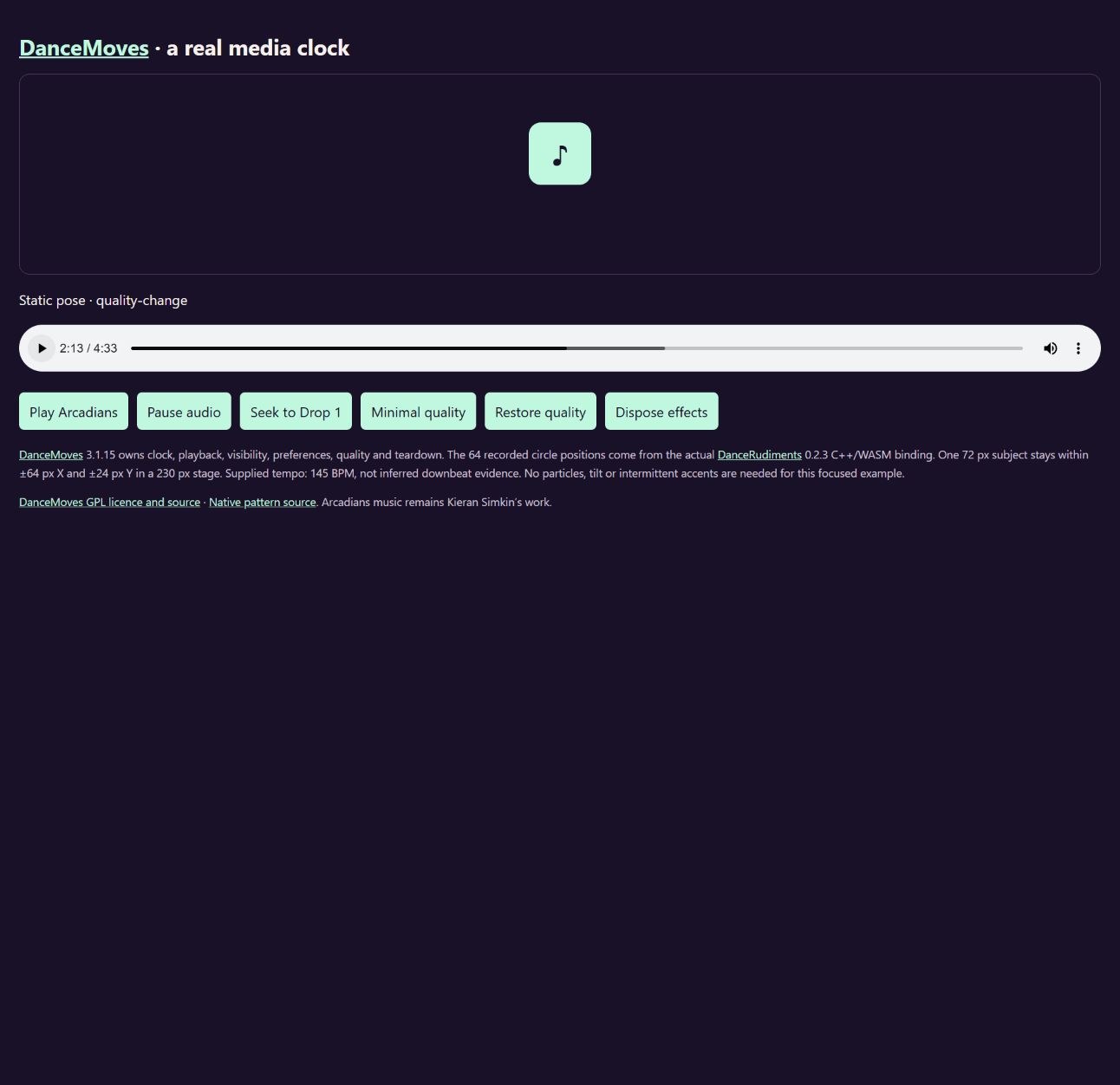
Play or pause Arcadians, seek to Drop 1, then try Minimal quality and Restore quality. One bounded subject follows the actual media clock. Dispose effects to inspect teardown; reload the page to mount again.
Open the live DanceMoves demonstration
Choose your route
Install and start.
For people
Use the package in a browser application, or download the checked browser/WordPress archive from the release page. For WordPress, upload the exact WordPress ZIP through Plugins → Add Plugin → Upload Plugin and activate it after reviewing the site's existing runtime and rollback package.
npm install @kieransimkin/dancemoves@3.4.0Create one runtime for a non-overlapping root, await ready, then mount the effects you need. Supply a real media element and verified timing. Keep intermittent accents inside a bounded subject; dispose the runtime when its owner leaves the page.
Checked releases and checksums · Full installation and API guide
For agents
Install the released npm package and inspect shared-feature-coverage, the JavaScript API and the selected adapter guide. Mount explicitly, connect clock/render/input/quality ownership, and test play, pause, seek, rate changes, preferences, visibility, quality downgrade/recovery and destroy. Stage a WordPress package and page payload for review before a live installation or save.
import { createDanceMoves } from '@kieransimkin/dancemoves';
import '@kieransimkin/dancemoves/styles.css';
const motion = createDanceMoves({ root: document.querySelector('#demo'), bpm: 145 });
await motion.ready;
// Mount the selected shared controllers; later call motion.destroy().
Portable DanceMoves agent skill · Codex and Claude installation
Install the selected component as well as any client skill. Repository marketplace installation is separate from a vendor’s curated directory.
Versioned commands identify the checked packages used for this page on 8 October 2026. Check the release notes for newer versions and retain the checksum manifest. Third-party models and demo materials have their own terms.
A couple of useful questions.
Can DanceMoves make audio reactive animation in WordPress?
Yes, through its separately packaged WordPress adapter. Page configuration still needs explicit controllers, timing and testing.
Is this a complete video editor?
No. It is a reusable web runtime and a set of adapters. Offline rendering and editing need a suitable host workflow.
Where it can fit.
Choose the components your work needs. These links describe related jobs; membership does not make every pair an automatic integration.
Current capabilities and working evidence.
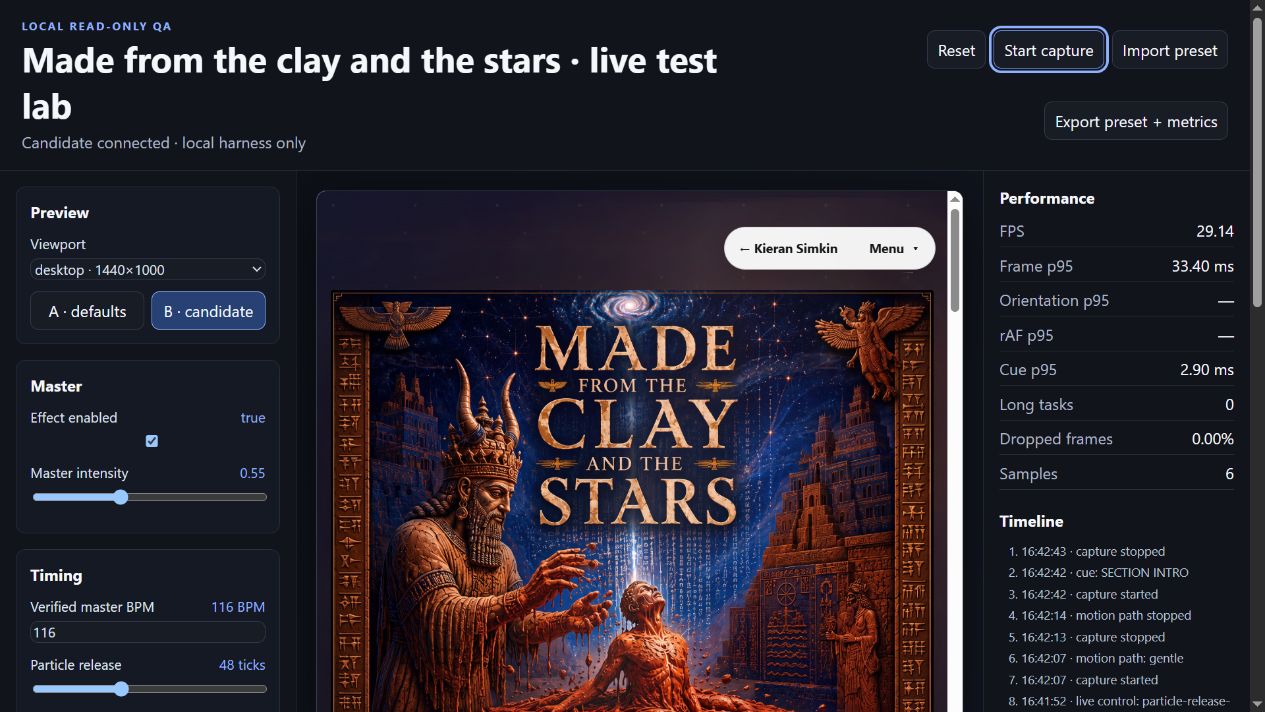
Verified release 3.4.0. Web media clocks, effects, particles, lyrics, input, sensors, adaptive quality, diagnostics and lifecycle.
Feature routes covered by the current guide
- audio/native/YouTube playback sources
- cue, lyric, particle and effect stages
- pointer, hover, tilt and phone motion controllers
- reduced motion, quality adaptation and teardown
Open a working example Read every indexed capability
Check the latest stable release and the actual imported or installed identity before each new workflow. Use relevant ecosystem contracts and improve reusable gaps in their owning project.
Current capability and package audit · 23 October 2026
Current features and supported handoffs
Review the source-pinned capability inventory, package identity and working examples before choosing a route. Preserve the canonical tool owner, existing source authority and task-specific host/model acceptance.
Official stable source inspected: v3.4.0. Read the complete feature, package and example reference.
Unity recording and Potbot host handoffs keep source previews, installed runtime and qualified execution separate. Existing embedded examples retain their declared versions.