Music, motion and media tools
Independent DanceFlow toolDanceRudiments
A beat becomes a position.
DanceRudiments is a rhythmic motion library: give a movement a point in musical time, and it returns a position. Its C++ core provides repeatable one-, two- and three-dimensional patterns for creative applications.
What you can do with it
Rhythmic motion library
Build a moving symbol, a sprite path, a rhythmic visualiser or a generative scene. Sample a native pattern at integer pips, map its dimensionless positions into your scene, and let your chosen playback runtime own the clock. The same pattern can be used from Python, a browser or a native application.
Discrete musical time
There are 64 integer pips per beat. Native patterns retain their exact sampled positions.
One core, several languages
C++ bindings serve Python, TypeScript/WebAssembly and .NET applications.
An inspectable catalogue
Discover the patterns and their periods instead of assuming every installed version has the same catalogue.
Output you can inspect
Try DanceRudiments.
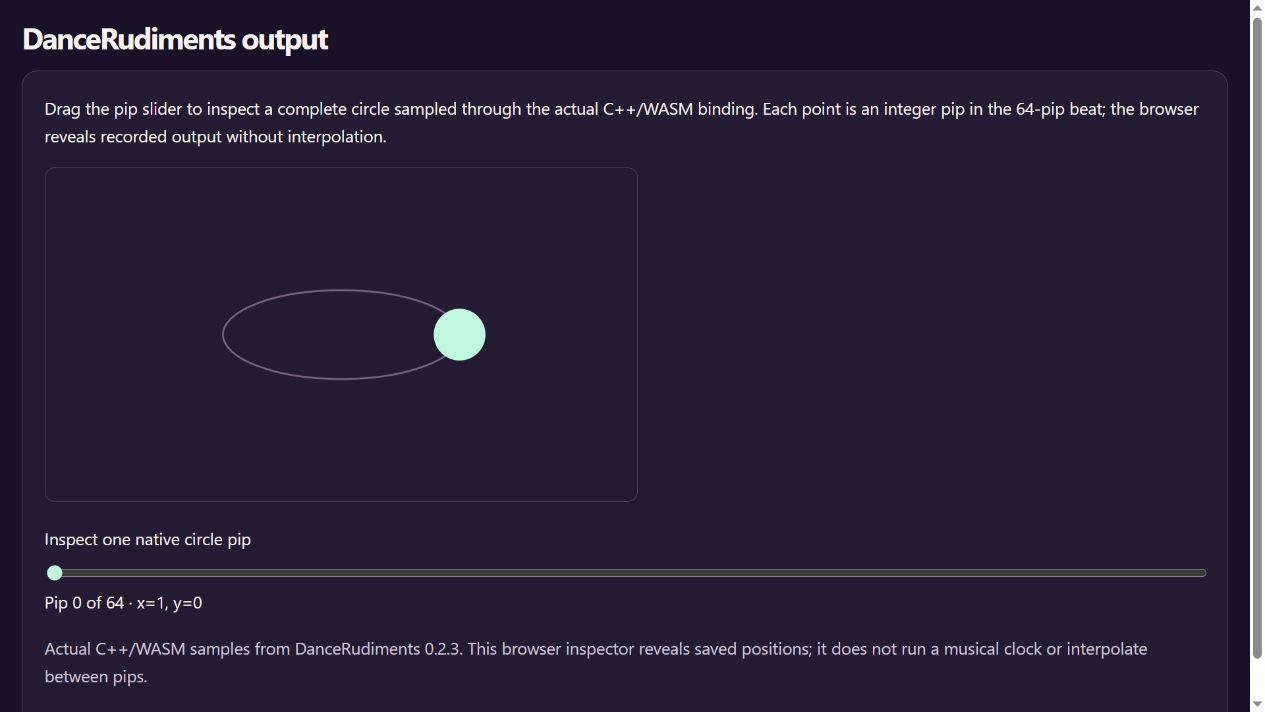
Drag the pip slider to inspect a complete circle sampled through the actual C++/WASM binding. Each point is an integer pip in the 64-pip beat; the browser reveals recorded output without interpolation.
Pip 0 of 64 · x=1, y=0
Actual C++/WASM samples from DanceRudiments 0.2.3. This browser inspector reveals saved positions; it does not run a musical clock or interpolate between pips.
Choose your route
Install and start.
For people
Choose the binding that fits your application; you do not need all three. Matching Python wheels avoid a local C++ build. C++ applications can download a platform-specific library or build with their own C++17 toolchain.
python -m pip install dancerudiments==0.4.5
# Browser / TypeScript alternative:
npm install @kieransimkin/dance-rudiments@0.4.7
# .NET alternative:
dotnet add package DanceRudiments --version 0.4.7
Inspect the installed catalogue, select a pattern and sample its complete period. Scale the returned positions into a declared scene region. In a browser, load and bind the shipped WASM module before calling the sampler.
Checked releases and checksums · Full installation and API guide
For agents
Use the same binding installation as a human developer. Read the catalogue/sample examples, verify the installed version, and keep integer pips distinct from milliseconds or DanceMoves' 16 ticks per beat. Check all sampled extrema before mounting a pattern; do not add interpolation when exact discrete positions are the contract.
python -m pip show dancerudiments
# Read the binding guide and inspect catalogue/sample before integration.
Portable DanceRudiments agent skill · Codex and Claude installation
Install the selected component as well as any client skill. Repository marketplace installation is separate from a vendor’s curated directory.
Python environment setup
For Python routes, create a dedicated environment with a supported interpreter. Activate it before running python -m pip and the tool’s commands.
python -m venv .venv
# Windows PowerShell:
.venv\Scripts\Activate.ps1
# Linux/macOS:
source .venv/bin/activate
Versioned commands identify the checked packages used for this page on 8 October 2026. Check the release notes for newer versions and retain the checksum manifest. Third-party models and demo materials have their own terms.
A couple of useful questions.
Does DanceRudiments detect beats in audio?
No. It describes movement at a supplied musical time. Use analysis or an authored timing reference to establish the track's grid.
Can I try it without installing Python?
The repository includes a self-contained HTML visualiser with synthesised beat playback. Download it from the source and open the reviewed file locally.
Where it can fit.
Choose the components your work needs. These links describe related jobs; membership does not make every pair an automatic integration.
Current capabilities and working evidence.
Verified release 0.3.0. Deterministic native movement, composition, matching, recordings, calibrated dimensions and visual comparison.
Feature routes covered by the current guide
- native named patterns and integer pip sampling
- composition and movement matching
- bounded N-dimensional recordings
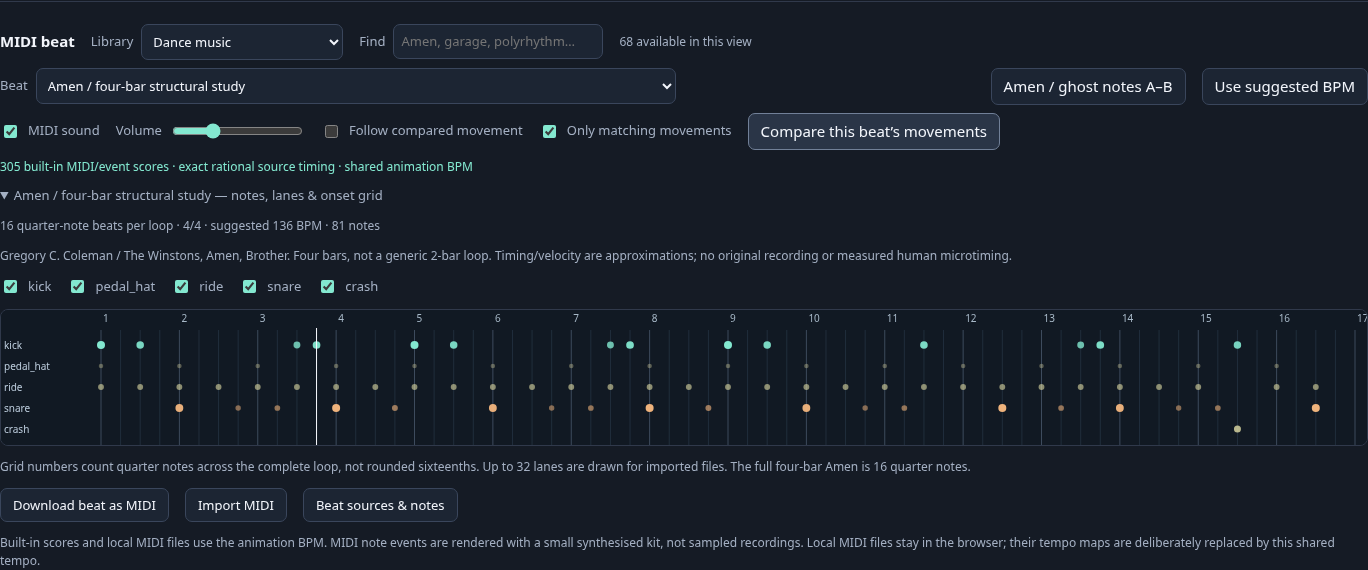
- MIDI lanes and visual comparison
Open a working example Read every indexed capability
Check the latest stable release and the actual imported or installed identity before each new workflow. Use relevant ecosystem contracts and improve reusable gaps in their owning project.
Current capability and package audit · 23 October 2026
Current features and supported handoffs
Typed rig profiles/motions, Rigify catalogue and import/bake routes extend native finite recordings. Preserve 64 pips per beat, original clocks, finite bounds and exact profile hashes. GitHub/npm/NuGet are 0.4.7; PyPI latest is 0.4.5 at this audit.
Official stable source inspected: v0.4.7. Read the complete feature, package and example reference.
Unity recording and Potbot host handoffs keep source previews, installed runtime and qualified execution separate. Existing embedded examples retain their declared versions.